BLOG
A Children’s Parade
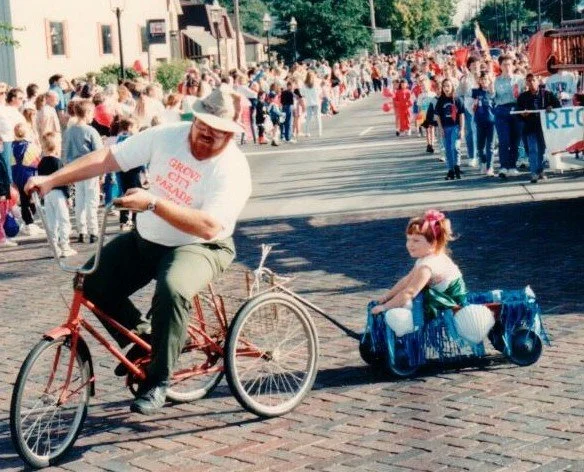
The first Grove City Children’s Parade occurred in 1991 and hundreds of children gathered at the OLPH parking lot as a unit in the Grove City Community Parade. It was planned to provide a shorter walking distance for younger participants. Bruce Close was the Children’s Parade director and that same year, a Twins Division was created with nearly 25 participants. The Grove City Community Parade is known today as the Arts in the Alley Parade which is held each year in September.

Rome and Alton
In 1836, James Bryden and Adam Brotherlin created 64 lots on land they owned naming the community Rome; Alton, located just west of Rome, was created the same year by Thomas Graham and quickly Alton prospered and became Prairie Township’s largest settlement. Rome and Alton were communities located on the National Road (US Rt. 40) just west of Columbus and were among the early settlements in Franklin County. Long before either town was created, several taverns operated on the National Road as stage coach stops; the oldest tavern built in Rome before 1812. Several religious congregations formed at Alton as early as 1843 but it wasn’t until 1883 that the first house of worship (pictured) was built as a Methodist Episcopal Church where circuit riding preachers from Columbus conducted services. After Billy Sunday held a series of revival services at Alton in the late 1880s, neighboring Rome residents decided to organize their own place of worship instead of traveling to Alton. Billy Sunday, the nation's most famous evangelist at the time, had influenced Rome residents to organize what became known as the Community House eventually a Methodist Episcopal Church.

Green’s Heritage Days
A once popular fall event attended by many was Green’s Heritage Days, a weekend event at Commercial Point that showcased steam powered farm equipment harvesting grains. It provided an opportunity for people to see antique farm machinery in operation. The food was great and the fresh apple cider was popular but fighting off yellow jackets could be a challenge. For many years, the family refurbished many antique horse drawn vehicles including stage coaches, milk delivery vehicles, wagons and carriages.

Pay the Toll
Broadway was once a dusty, dirt stage coach road that connected Columbus and Harrisburg. Earl Nicholson believed that road was a corduroy or wood plank road and originally a turnpike where a 10-cent fee was charged to recover the $35,602 construction cost. The fee was unpopular and the toll gates were removed before the road expense was recovered. Uriah Lathrop, surveyor and engineer for the project, never mentioned the type of road he built. In 1928, Broadway got a major upgrade when concrete was poured as a base with bricks placed over the concrete and a coat of asphalt layered over the bricks, according to Paul Grossman, who’s father Herman Grossman Sr., was Grove City mayor at the time. In 1931, the bricks were exposed when the road surface was again upgraded to a concrete surface, according to Roy Grossman. The bricks were never seen again until 1989 when Broadway was improved and the old brick road surface was exposed.

Cread Lawless
There’s a playground on Arbutus Avenue south of Kingston Avenue called Cread Lawless Park, but few residents today know the history of the name. Marshal Cread Lawless, a lifetime resident of Grove City, started to build his home on Arbutus during World War II when construction material was in short supply. For years, he and his wife, Ruth, lived in a small cinder block garage until building materials were available to finish the house they occupied throughout their life. Cread was introduced to Beulah Park early in life. His mother did the laundry for all jockeys at the race track and the track eventually became the place he worked many of his adult years. His first job at Beulah Park was working with eight other men moving the starting gate from Grove City to other Ohio horse tracks. At the end of a race meet, the track was moved to Lancaster and as far away as Ascot Park near Cuyahoga Falls. It was towed behind a truck and guided on the road with a steering wheel similar to that on a ladder fire truck. One race day job he disliked was monitoring and directing traffic at the curve in front of St. John’s Lutheran Church on Columbus Street, a frequent bottleneck. He said he was often called everything but a gentleman working that location.